
Short-Term vs Long-Term Rentals in Cairns: The Pros and Cons for Property Owners

Could your investment property work harder as a short-term rental?
For Cairns property owners, short-term accommodation offers the opportunity to earn income from paying guests while keeping some flexibility to enjoy the property themselves. But higher nightly rates come with additional costs, more moving parts and less predictable income.
Long-term rentals have their own strengths, particularly for owners who value consistency and a simpler operating model.
At Pebble Stays, our view is that the right choice starts with your property, your goals and what you keep after expenses.
Why choose short-term rentals?
1. The potential to earn more
Short-term accommodation allows you to charge by the night and adjust prices for different dates. When demand supports it, that can create an opportunity to generate more gross income than a fixed weekly rental.
However, a busy month does not tell you how the property will perform over a full year. The result depends on your average nightly rate, booked nights and operating costs.
The real advantage is higher net income, if the property can achieve it. Higher booking revenue alone is not enough.
2. Flexibility to use your own property
A short-term rental can suit owners who want an investment property that also serves as a holiday base.
You can reserve available dates for yourself or visiting family, provided they do not conflict with existing bookings or management arrangements.
The trade-off is lost earning potential. Blocking out popular holiday dates may mean giving up some of the property's most valuable booking opportunities.
3. More ways to make your property stand out
With short-term accommodation, the guest experience gives you additional ways to compete.
An appealing outdoor area, a large pool, thoughtful styling or a well-equipped kitchen can give guests reasons to choose your property.
Our approach is to ask two questions: Does the location give people a reason to stay? Or does the property itself create that reason?
A conveniently located apartment might appeal to guests who want to explore on foot. A house further from the main attractions may need a stronger drawcard, such as an inviting pool and outdoor entertaining area.
These features do not guarantee bookings, but they help define who the property is for and how to market it.
4. Regular opportunities to check the property
Cleaning between stays creates frequent opportunities to identify maintenance issues, damaged items and missing supplies.
That does not eliminate wear and tear. More guest changeovers also mean more handling of furniture, linen and equipment. The benefit comes from having a reliable process for checking and reporting issues.
What are the disadvantages of short-term rentals?
1. Income is less predictable
Bookings can vary from month to month. Cancellations, competing accommodation and changes in travel demand can all affect results.
Owners need to be comfortable with quieter periods while regular property expenses continue.
A sensible assessment considers a full year and tests what happens if occupancy or nightly rates fall below expectations.
2. There are more operating costs
Short-term rentals generally require owners to supply and maintain a fully equipped property. Costs to consider include:
Furniture, appliances, artwork and initial styling.
Linen, towels, kitchenware and replacement items.
Electricity, internet and guest supplies.
Cleaning and laundry.
Booking platform charges and management fees.
Maintenance, suitable insurance and applicable property charges.
Booking platform fees also reduce the amount owners receive.
Even when guests pay a cleaning fee, owners should compare the amount collected with the actual cleaning and laundry bill.
3. It requires active hospitality management
Guest enquiries, pricing, check-in instructions, cleaning schedules and unexpected problems all need attention.
A guest arriving late at night with an access issue cannot necessarily wait until the following business day.
Professional management can reduce the owner's day-to-day workload, but its cost needs to be included when comparing the two rental options.
4. Suitability needs to be checked before you commit
Before furnishing or advertising a property, confirm the planning requirements, any relevant body corporate conditions, insurance cover and lending arrangements for its intended use.
Do not assume that another holiday rental nearby means your property has the same permissions or circumstances.
What are the advantages of long-term rentals?
1. More predictable rental income
An agreed weekly rent makes budgeting more straightforward while the property is occupied and rent is being paid.
Vacancies, arrears and unexpected repairs remain possible, but owners are not relying on a stream of new guest bookings.
2. A simpler operating model
An unfurnished long-term rental generally does not require hotel-style linen, guest supplies, booking calendars or cleaning after every stay.
There is still maintenance and tenancy management to organise, but fewer accommodation-related tasks.
3. Lower setup requirements
If the property is suitable for an unfurnished tenancy, owners can avoid the substantial initial outlay of furnishing and equipping it for paying guests.
This can make long-term renting attractive when preserving cash is a priority.
What are the disadvantages of long-term rentals?
The main trade-offs are reduced flexibility and fewer opportunities to earn premium nightly rates.
The property becomes the tenant's home, so owners cannot simply reserve a week for their own holiday. Rental income also does not adjust nightly in response to visitor demand.
There can still be gaps between tenancies, letting costs and repairs. Long-term renting offers a different risk profile, rather than a guarantee of uninterrupted income.
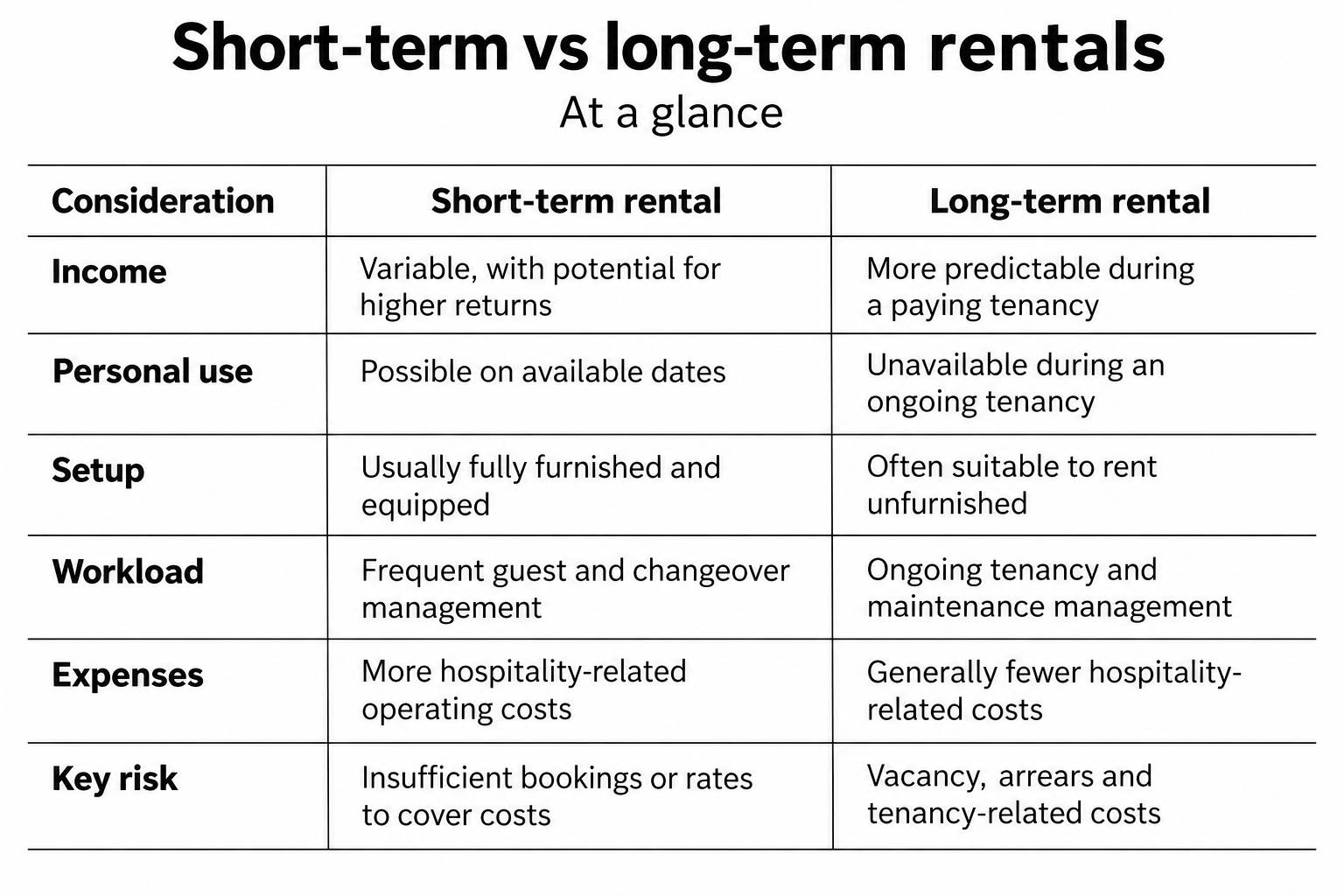
Short-term vs long-term rentals at a glance
Which option is right for your Cairns property?
Start with realistic annual figures for both options.
For short-term accommodation, estimate booked nights and average nightly revenue, then deduct all operating expenses. For long-term renting, allow for vacancy, management, letting costs and maintenance.
Include the property costs that apply to both options, and keep the treatment of loan repayments and tax consistent. Allow for the initial short-term rental setup cost separately so you can assess how long any additional earnings might take to recover it.
Our recommendation is to choose the option that delivers the strongest combination of net income, manageable risk and flexibility for your circumstances.
Short-term accommodation may be appealing if your property offers a compelling guest experience and you can accommodate variable income. Long-term renting may be a better fit if your priority is consistency and a simpler setup.
Get the right support for either option
Considering short-term accommodation? Contact Pebble Stays to discuss your property and whether Airbnb management in Cairns could suit your goals.
For all your long-term rental needs, our partner company Benchmark Real Estate has you covered. Their team offers property management in Cairns and surrounds.
Whether you choose holiday letting or a long-term tenancy, the starting point is the same: understand your property's potential and make the numbers work for you.
